

The CLARITY Act: Mapping the Institutional Gold Rush
Where the money flows when crypto “gets regulated” — from Coinbase’s custody monopoly to Bitcoin miners pivoting to AI — and the honest case for betting on Wall Street’s blockchain future.

StatsLab AI Inc. unveils the first Rubryk authored deep-research and analysis article in the debut series, “Unlocking Financial Intelligence”. This is not Financial Advice.
The Digital Asset Market CLARITY Act has a 35% chance (at the time of writing) of becoming law before the end of 2026, according to Polymarket prediction markets. That’s down from 74% in May, after the bill hit a uniquely American snag: President Trump holds $1.4 billion to $2.3 billion in crypto assets, and Senate Democrats refuse to pass the legislation unless he divests. The bill is literally stalled because the man who would sign it into law stands to profit massively from doing so.
And then, on July 16—one day before the White House meeting that would send Polymarket odds rebounding—Citadel Securities invested $400 million in Crypto(dot)com at a $20 billion valuation. The exchange’s native token, CRO, surged 25% in minutes.
But on-chain data shows whale transactions on CRO had spiked +650% to +1,100% in the week before the announcement.
The smart money wasn’t reacting to news. They were positioning before it went public.
Meanwhile, Coinbase has quietly positioned itself as the custodian for 9 out of 12 Bitcoin spot ETFs, controlling over $65 billion in institutional assets. Bitcoin miners have announced $70–90 billion in contracts to convert their facilities into AI data centers for Microsoft, Google, and AWS. And tokenized US Treasuries have grown from $6 billion to $33.5 billion in 18 months, with 80% of that capital sitting in compliant, KYC-walled products that retail traders can barely access.
This piece is not a stock tip. It is a map: where the value sits inside the regulatory infrastructure being built for crypto, which US-listed companies capture each layer, and the honest case for and against two distinct approaches.
If the bill passes, it won’t free crypto—it will sanitize it for institutional adoption while locking retail traders behind surveillance walls.
“The question isn’t whether you believe in decentralization. It’s whether you want to bet on the people building the cage.”
Where the value sits
Follow the capital flow through one typical institutional crypto transaction under the CLARITY Act framework:
Custody & exchange: ~30–40% of margin. Spot Bitcoin ETFs pay custody fees to Coinbase at ~25 basis points annually. On $65 billion, that’s ~$162 million in steady, high-margin revenue. Add trading fees, staking, and prime brokerage, and the custody layer is the first place institutional capital touches crypto.
Treasury holdings: ~20–30%. Companies like MicroStrategy hold Bitcoin directly on their balance sheets. The CLARITY Act’s classification of Bitcoin as a “digital commodity” removes the legal ambiguity that kept CFOs on the sidelines. Corporate treasury plays are a bet that more companies follow this path.
Infrastructure pivot: ~25–35%. Bitcoin miners own land, power contracts, and grid access—assets worth far more for AI data centers than for mining. Contracts with hyperscalers (Microsoft, Google) carry 80–85% gross margins and multi-year lock-ins. The regulatory clarity that legitimizes Bitcoin also blesses this pivot.
Tokenization platforms: ~10–20%. Real-world asset (RWA) tokenization—US Treasuries, private credit, commodities—has grown to $33.5 billion (excluding stablecoins). The CLARITY Act’s Title V provisions explicitly define how tokenized securities work on-chain, creating the legal scaffolding for trillions more to follow.
Two features matter for investors. First, the infrastructure layer captures value regardless of which tokens pump. Coinbase earns fees whether you’re trading Bitcoin, Solana, or a memecoin. Second, institutional players and retail holders experience completely different regulatory realities.
The CLARITY Act creates legal pathways for Wall Street while imposing KYC, AML, and surveillance requirements that systematically lock out permissionless trading. That split—clarity for institutions, friction for individuals—is the defining tension of the bill.
Two ways to play it
Path A — Direct crypto exposure (the names everyone knows)
These are the companies whose stock price moves when Bitcoin pumps or regulatory headlines hit: Coinbase (COIN), MicroStrategy (MSTR), and the spot Bitcoin ETF issuers (BlackRock, Fidelity, Grayscale, ARK, VanEck).
The bull case. Coinbase has a structural moat. It’s the default institutional custodian, integrated into Visa and Mastercard settlement rails, and holds a money transmitter license across major US jurisdictions. The CLARITY Act cements its role as the compliant gateway for institutional capital. Spot Bitcoin ETFs have pulled in $79+ billion since January 2024; if the bill passes and regulatory uncertainty lifts, that could double within 18 months. MicroStrategy’s 450,000+ BTC treasury gets legal clarity, making it the purest leveraged bet on Bitcoin without touching a crypto wallet. When the bill advances in the Senate or Trump cuts a deal on the ethics provisions, these stocks move first.
The bear case. These are binary bets on a 35%–probability bill, priced as if passage is certain. Coinbase’s retail volume has been declining as KYC/AML walls go up; institutional custody revenue is steady but doesn’t justify a market cap swinging with Bitcoin volatility. MicroStrategy is a debt-fueled gamble—if Bitcoin crashes, the company’s interest obligations crush it. ETF fee compression is inevitable; BlackRock charges 0.25%, but the Morgan Stanley Bitcoin Trust undercuts everyone at 0.14%. You’re also betting that Democrats blink on the Trump conflict-of-interest issue, which has already tanked Polymarket odds from 74% to 24% before the recent rebound.
Path B — The infrastructure pivot (the AI data center story)
These are the former Bitcoin miners now signing multi-billion-dollar contracts to host AI training clusters: Iris Energy (IREN), TeraWulf (WULF), Core Scientific (CORZ), Hut 8 (HUT), plus the hardware suppliers that enable it—Vertiv (VRT) for power and cooling, Astera Labs (ALAB) for GPU interconnects, Arista Networks (ANET) for networking.
The bull case. This is the asymmetric trade hiding in plain sight. IREN has a $9.7 billion Microsoft contract for 76,000 Nvidia GB300 GPUs at 85% EBITDA margins. TeraWulf holds $13 billion in contracted revenue. Core Scientific is already collecting rent from CoreWeave at 80–85% cash gross margins. Combined, these three companies have market caps around $22 billion against $70–90 billion in announced contracts. If they execute—sites energized, GPUs deployed, hyperscalers paying—the upside is 3–10x over 2–3 years. The CLARITY Act matters because it removes the legal stigma from Bitcoin mining, making banks willing to finance these conversions.
You’re not betting on Bitcoin’s price; you’re betting on AI infrastructure demand and the miners’ ability to deliver power-dense, grid-connected real estate faster than purpose-built data centers.
The bear case. Execution risk is massive. Only ~25% of contracted capacity is actually energized. Construction timelines slip. Power interconnects fail. Hyperscalers renegotiate or walk. Hut 8 announced a $9.8 billion deal but neither site is operational until 2027, and it’s trading at 45x sales on future projections. IREN’s Microsoft contract is real, but if it misses a milestone, the stock reprices violently. Meanwhile, traditional data center REITs (Equinix, Digital Realty) are also expanding AI capacity with lower execution risk. Vertiv, Astera, and Arista are excellent businesses, but autonomy is a slice of their revenue—you’re paying full-stack valuations for partial thematic exposure.
How the two compare
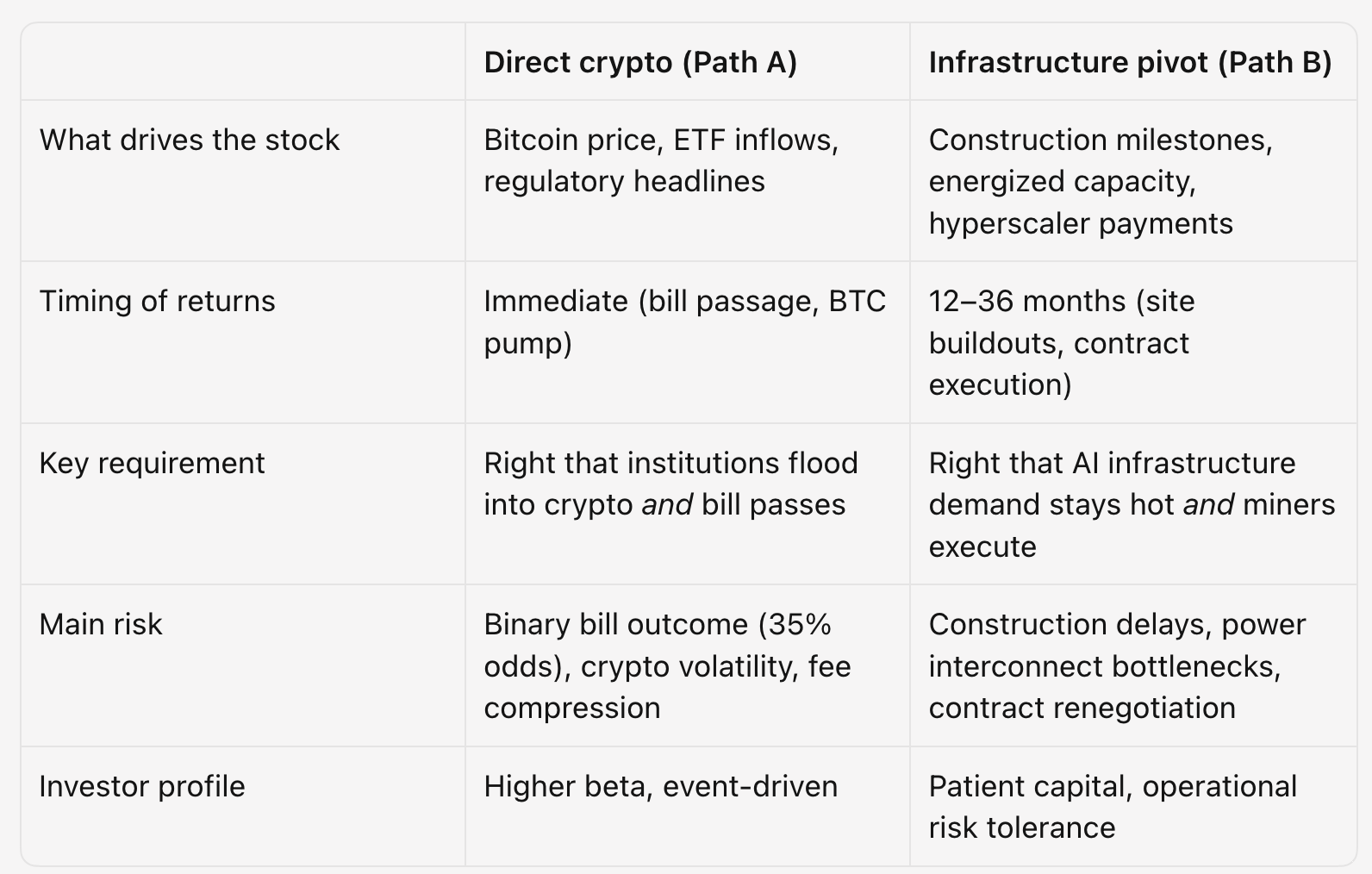
Neither path is “safe.”
Path A is a leveraged bet on regulatory outcomes and Bitcoin’s next move.
Path B is a bet on industrial project execution in a sector where most participants have never built a hyperscale data center before.
A portfolio can hold both: direct exposure for the CLARITY Act catalyst, infrastructure plays for the longer AI convergence story.
The US-listed names, by role
Restricting to companies buyable in a standard US brokerage (NYSE / Nasdaq):
Custodians & exchanges: Coinbase (COIN) — 9/12 Bitcoin ETFs, $65B+ custody AUM, institutional settlement integration.
Bitcoin treasuries: MicroStrategy (MSTR) — 450,000+ BTC on balance sheet, leveraged proxy.
Spot Bitcoin ETFs: BlackRock IBIT ($54B), Fidelity FBTC ($13.5B), Grayscale GBTC ($11B), ARK ARKB ($2.5B), Bitwise BITB ($2.7B), VanEck HODL ($1.1B), and 6 others. Issuers include publicly traded BlackRock (BLK) and ARK (ARKK).
Alt-crypto ETFs: Canary Capital HBR (Hedera HBAR), $49M AUM — first alt-coin spot ETF, added staking rewards in June 2026.
Old miners (pure Bitcoin): Marathon Digital (MARA), Riot Platforms (RIOT), CleanSpark (CLSK) — exposure to Bitcoin price, post-halving margin compression, limited AI pivot announcements.
AI data center pivots: Iris Energy (IREN) — $9.7B Microsoft, 5 GW pipeline; TeraWulf (WULF) — $13B contracted; Core Scientific (CORZ) — $10–12B CoreWeave, already energized; Hut 8 (HUT) — $9.8B+ Beacon Point; Applied Digital (APLD), Cipher Mining (CIFR) — mid-cap diversified plays.
Supporting infrastructure: Vertiv (VRT) — liquid cooling & power distribution; Astera Labs (ALAB) — GPU interconnects; Arista Networks (ANET) — data center networking.
For readers wanting exposure to tokenized RWA protocols (Ondo, Aave, Maple, Morpho, Pendle) or international exchanges, most are not US-listed equities. The crypto themselves (XRP, HBAR, ALGO, AVAX, LINK) trade on Coinbase and other platforms but aren’t stocks. Full project profiles are in the research package.
The whale signal: Who knew what, when?
On July 16, 2026—the day before the White House meeting that sent Polymarket odds rebounding—Citadel Securities announced a $400 million investment in Crypto(dot)com at a $20 billion valuation. This was Crypto(dot)com’s first institutional funding round in its 10-year history, and the market reaction was immediate: the exchange’s native token, CRO, surged 25% in minutes, jumping from $0.056 to $0.07.
But here’s what makes the timing suspicious: whale activity on CRO had spiked +650% to +1,100% in the week before the announcement, according to Santiment on-chain data. Large holders were accumulating while the price sat quietly near support levels—classic front-running behavior. The whales weren’t reacting to the news. They were positioning before it went public.
Crypto(dot)com isn’t a random bet. The company received conditional OCC approval in February 2026 to establish a national trust bank, positioning it as a federally regulated custodian for digital assets. The $400 million is explicitly earmarked for expansion into “tokenized securities, derivatives, and prediction markets”—all asset classes that need the CLARITY Act to have clear regulatory status. Citadel isn’t gambling on a 35%-probability bill. They’re betting that the infrastructure Crypto(dot)com built becomes essential the moment regulatory clarity arrives.
The pattern extends beyond CRO. XRP whale-to-retail spreads hit 50.9% in early July, with large holders accumulating while retail stayed cautious ahead of the “crucial July 17 congressional hearing on the CLARITY Act.” XRP spot ETFs pulled in $62 million in June alone, pushing cumulative inflows to $1.48 billion. Meanwhile, dormant Bitcoin wallets holding $383 million and $188 million moved for the first time in 7–8 years, transferring to new addresses (not exchanges) in what analysts interpret as strategic repositioning, not sales.
Senator Kirsten Gillibrand has explicitly flagged the insider trading risk, stating that lawmakers could be “using their positions to gain an edge in crypto markets” by trading on non-public regulatory information. Her concern isn’t theoretical—it’s the primary reason Democrats are blocking the bill. The ethics provision dispute isn’t about abstract governance principles. It’s about whether senior officials, their families, and those with access to private Senate negotiations can legally front-run the very legislation they’re writing.
The timeline tells the story:
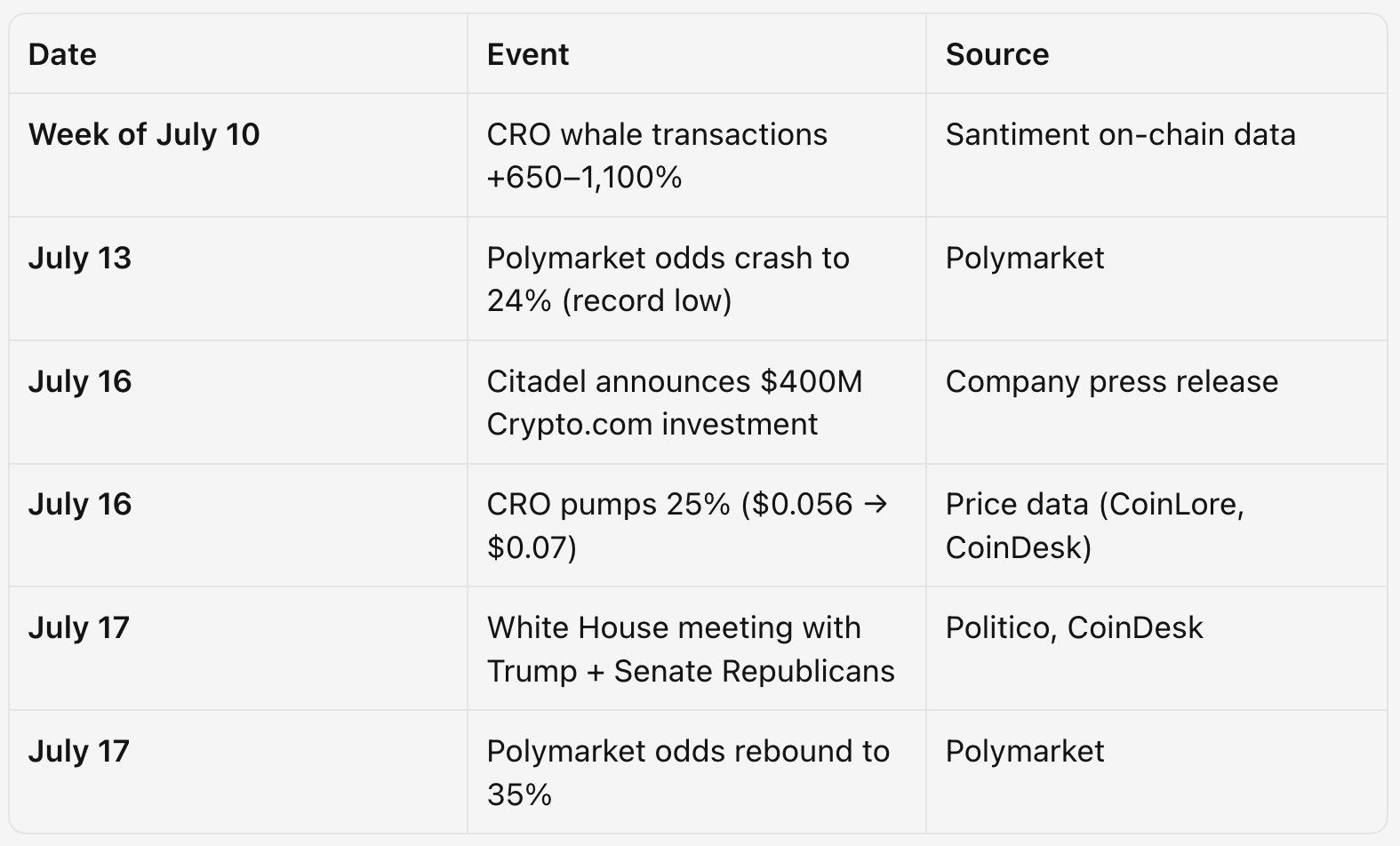
Citadel Securities is one of the world’s largest market makers. They process liquidity across every major financial market.
A $400 million check isn’t speculative capital—it’s a strategic bet on regulatory infrastructure.
And the whales buying CRO and XRP ahead of public announcements? They’re not reading tea leaves. They’re reading the room.
Risks that apply to the whole theme
The bill might not pass. Polymarket odds sit at 35%. The Trump conflict-of-interest standoff is unresolved. If Democrats hold the line and Republicans can’t find 7 crossover votes, the bill dies. All institutional clarity bets reprice.
The whale activity could be wrong. Front-running only works if the anticipated event happens. If the CLARITY Act stalls into 2027 or dies entirely, the whales holding CRO, XRP, and repositioned BTC are sitting on bets that didn’t pay off. Citadel’s investment becomes a sunk cost in a “failed crypto platform” at a $20 billion valuation that evaporates.
Regulatory “clarity” means surveillance. The bill’s DeFi provisions, stablecoin yield bans, and “voluntary freeze” safe harbors systematically advantage institutions over retail. If you’re betting on adoption, you’re betting on a two-tier system where Wall Street wins and permissionless trading dies.
Execution risk (Path B). Contracted capacity isn’t energized capacity. Construction delays, power interconnect failures, and hyperscaler renegotiations can destroy stock prices faster than Bitcoin volatility.
Crypto winter. If Bitcoin crashes below $40k or stablecoin regulations tighten further (GENIUS Act provisions), institutional appetite evaporates. Coinbase revenue collapses, ETF outflows accelerate, and even the AI pivot stocks reprice on “tainted” Bitcoin mining heritage.
China & offshore competition. Binance, OKX, and offshore platforms still dominate global retail volume. The CLARITY Act only controls US-domiciled flows.
What to watch
One signal captures the institutional adoption story: Coinbase custody AUM. If it crosses $100 billion (from $65B today), institutions are flooding in. Near-term signposts: the Senate floor vote (targeted for the week of July 20, 2026), Trump ethics provision compromise, and Polymarket odds (real-time insider sentiment tracker—watch for sudden moves before public announcements).
On the whale activity front, monitor CRO and XRP on-chain metrics for continued large-holder accumulation. If whale-to-retail spreads stay elevated or spike again before the next legislative milestone, it’s a signal that connected players are still positioning. Watch for dormant wallet reactivations (especially 5+ year old BTC addresses)—they often precede major market structure shifts.
On the infrastructure side, watch energized MW announcements from IREN, WULF, and CORZ—contracted capacity means nothing until GPUs are racked and power is live. For RWA adoption, track tokenized Treasury AUM (currently $33.5B, growing ~300% YoY). And follow Crypto(dot)com’s progress toward finalizing its OCC national trust bank charter—if approved, it becomes the second major federally regulated crypto custodian after Coinbase.
Bottom line
The CLARITY Act isn’t about freeing crypto—it’s about making it safe for BlackRock. $65 billion already sits in Coinbase’s custody vaults. $70–90 billion in miner-to-AI contracts are inked. $33.5 billion in tokenized Treasuries prove institutions will use blockchains if you wrap them in compliance. And now Citadel Securities just bet nearly half a billion dollars that Crypto(dot)com’s infrastructure—built for tokenized securities, derivatives, and prediction markets—becomes essential the moment the bill passes.
The whales saw it coming. CRO transactions spiked +1,100% before the Citadel announcement went public. XRP whale-to-retail spreads hit 50.9% ahead of the July 17 hearing. Dormant Bitcoin addresses holding hundreds of millions reactivated after 7–8 years.
These aren’t retail traders reading headlines. These are large holders with access to information the market doesn’t have yet.
The question isn’t whether this happens. It’s whether you want exposure to the people building the rails—Coinbase for custody, IREN/WULF/CORZ for AI infrastructure, MSTR for leveraged Bitcoin, Crypto(dot)com for tokenized securities infrastructure—or whether you’d rather watch from the sidelines as Wall Street onboards into a surveillance-ready, KYC-gated version of the system crypto was built to escape.
The only thing the CLARITY Act clarifies is who profits: the institutions writing the rules, the custodians charging the fees, the miners who figured out their land was worth more to AI than to Bitcoin, and the market makers who knew which way the wind was blowing before the rest of us could read the forecast.
Everyone else gets a front-row seat to watch the revolution get gentrified.
Rubryk’s Rant
They told you Bitcoin was freedom money. Turns out the only freedom it bought was Citadel’s freedom to invest millions Crypto(dot)com before the rest of us figured out the game. The CLARITY Act won’t make crypto clearer—it’ll make it quieter. The whales will keep accumulating. The senators will keep trading. The miners will keep converting their rigs into AI data centers. And Coinbase will keep charging 25 basis points on every dollar that crosses the institutional threshold.
The revolution didn’t fail. It just got acquired. At a $20 billion valuation. In a deal announced one day before a White House meeting. While retail traders were still checking Polymarket odds and wondering why CRO was pumping.
You don’t have to like it. But if you’re going to play in a rigged game, you might as well know where the loaded dice are sitting.
About StatsLab
This is the first piece in our research series. StatsLab is an AI vision-powered trading intelligence platform built by traders who got tired of watching retail lose while institutions had all the tools.
What we do: Screenshot any chart. Our AI sees everything—patterns, indicators, support levels, the whole technical picture—and delivers institutional-grade analysis in 30 seconds. The same frameworks that Bloomberg Terminal users pay $24,000/year for, accessible to anyone with a trading idea.
Why we built it: Because they halted the buy button. Because they gated the intelligence. Because 90% of retail traders lose money, not because they’re stupid, but because they’re flying blind. We’re traders. We know what it’s like to miss your millions because you didn’t know when to take profit. So we built the platform that didn’t exist.
This research arm tracks the infrastructure being built beneath the narratives. The custody monopolies. The whale activity. The miner-to-AI pivots. The tokenization platforms. The conflicts of interest that stall bills in the Senate because the people signing them own $1.4 billion in the assets they’re regulating.
If you want research that treats you like an adult—no hype, no “10 coins to buy now,” just structure, data, and the uncomfortable truths hiding in the footnotes—we’re opening beta access now.
Join the StatsLab beta to get the next piece in your inbox before the whales read it.
StatsLab | Unlocking Financial Intelligence™
Welcome to the Platform Before the Trade™
This is research and commentary, not investment advice, and not a recommendation to buy or sell any security. Figures and market caps are as of July 2026 and move daily. Polymarket odds, ETF AUMs, and contract values are sourced from public data and move continuously. The author may hold positions in names discussed. Do your own work. We are Not Financial Advisors. AI makes mistakes.
*Sources for this section: Santiment on-chain data, Polymarket odds archive,
company press releases can be found on the Sources & Citations page.