

Breathing Burning Money: The Wildfire Infrastructure Thesis
Where the money flows when the sky turns orange — from HEPA filters flying off shelves to billion-dollar bets on clean air infrastructure — and the honest case for betting on a planet that can’t stop

Update from our last piece: One day before this publication, we released “The CLARITY Act: Mapping the Institutional Gold Rush”. We tracked Citadel’s $400 million Crypto(dot)com investment timing (announced one day before a White House meeting), CRO whale transactions spiking +1,100% before the news went public, and the institutional custody infrastructure being built beneath the regulatory narrative. We called out the plays: Coinbase (COIN) as the custody monopoly, Bitcoin miners (MARA, RIOT, CLSK) pivoting to AI infrastructure, AI data center companies (IREN, WULF, CORZ, HUT) with multi-billion-dollar contracts, Bitcoin ETFs (BlackRock’s IBIT, Fidelity’s FBTC) as the institutional on-ramps, and MicroStrategy (MSTR) as the leveraged treasury play.
Then July 20–21 hit.
On July 20, Hut 8 announced a second $9.8 billion AI data center lease, and IREN signed $2.8 billion in new cloud contracts. The market responded: HUT surged +17%, IREN jumped +19%, Cipher Mining (CIFR) rallied +11%, MARA climbed +9%, TeraWulf (WULF) added +6.4%, and RIOT rose +5%. The CoinShares Bitcoin Miners ETF gained +8.5%. Bitcoin moved +1%. The infrastructure thesis was printing.
On July 21, Treasury Secretary Scott Bessent announced the CLARITY Act was at the “one-yard line” for a Senate vote. Coinbase (COIN) surged +11.8% to $179.37—a move 7.6 times larger than Bitcoin itself. MicroStrategy (MSTR) gained +3.7%—2.4x Bitcoin’s move. Bitcoin miners extended their rally: MARA +5%, RIOT +8%, CLSK +6.66%. Bitcoin ETFs recorded $203 million in inflows on July 21 alone, extending their streak to six consecutive days and $930 million total. BlackRock’s IBIT dominated with $163.89 million—80.7% of the day’s total. Bitcoin rose +2% to $67,000.
The infrastructure companies we mapped—exchanges, miners, AI pivots, ETFs, treasury plays—outperformed Bitcoin by 2.4x to 7.6x because they are the direct beneficiaries of regulatory clarity, not just price exposure. Analysts cited the exact thesis we laid out: Coinbase’s $65 billion custody monopoly, the AI data center pivot validation, the institutional ETF on-ramp. We didn’t move markets. We mapped the structure before the catalysts hit.
Now let’s do it again.
We are not financial advisors.
StatsLab AI Inc. unveils the second Rubryk authored deep-research and analysis article in the debut series, “Unlocking Financial Intelligence”. This is not Financial Advice.
On July 16, 2026, the Air Quality Index (AQI) in Chicago hit 481 (hazardous). Detroit recorded 650, the worst in the city’s recorded history — some private monitors showed 874. Toledo clocked 800, breaking the EPA’s standard scale. Milwaukee, Ann Arbor, Minneapolis, Philadelphia, and New York all exceeded 200, pushing the entire Great Lakes region and Northeast into “unhealthy for everyone” territory. For comparison, anything above 300 is considered hazardous.
The EPA scale stops at 500.
These numbers blew past it.
This wasn’t the first time. In June 2023, New York City hit AQI 465 — the worst air quality in the city’s recorded history. The Manhattan skyline disappeared. Baseball games were postponed. Emergency rooms in Toronto saw an 80% spike in respiratory visits. And in 2023, Canadian wildfires emitted 1.3 billion metric tons of CO₂ and sent smoke so far it reached Europe and China, raising PM2.5 levels thousands of miles away.
The 2026 event was worse. Over 130 fires raged across northwestern Ontario, with at least 60 out of control. Smoke blanketed the Midwest and Northeast for days. Chicago and Detroit were ranked the most polluted cities in the world. And while millions were told to stay inside, a different story was unfolding: air purifier sales surged 5x to 10x overnight. Shelves emptied at Target, Walmart, Home Depot, and Meijer. Google searches for “air purifier” spiked +450%. Amazon’s top 50 bestsellers in home products were dominated by HEPA filters.
This piece is not a stock tip. It is a map: where the value sits inside the air filtration economy, which US-listed companies capture each layer, and the honest case for and against betting on a world where breathing clean air is becoming a luxury good. If wildfires are the new normal, someone is selling the solution.
The question isn’t whether you believe in climate change. It’s whether you want to bet on the people selling oxygen.
Where the value sits
Follow the capital flow through one typical consumer air filtration purchase during a wildfire smoke event:
Consumer air purification: ~35–45% of market. Residential HEPA units, from $50 budget filters to $1,000+ Dyson purifiers, make up the largest segment. When AQI spikes, demand surges 5x to 10x overnight. Brands like Levoit, Molekule, and Winix see website traffic jump 2,000%, and sales double in days. Google searches for “air purifier” increased 450% in 24 hours during the 2023 event. In 2026, air purifiers sold out across Detroit, Chicago, and NYC metro areas within 48 hours of the smoke arriving.
Commercial & industrial filtration: ~30–40%. HVAC systems for office buildings, hospitals, data centers, schools. This is the steady, high-margin recurring revenue — buildings upgrade filtration systems, replace filters quarterly, and sign multi-year contracts. The $4.66 billion HVAC filter market (2026) is projected to hit $6.21 billion by 2031 at 5.9% CAGR. Institutional buyers (healthcare, manufacturing, cleanrooms) demand compliance with ASHRAE and EPA standards.
Industrial air filtration: ~20–30%. Factories, semiconductor fabs, pharmaceutical cleanrooms, and aerospace. High-efficiency HEPA and ultra-low particulate air (ULPA) filters for environments where contamination means millions in losses. This segment is growing at 6.0% CAGR toward $10.78 billion by 2033, driven by stricter workplace air quality regulations.
Automotive & personal protection: ~10–15%. Cabin air filters for vehicles, N95 respirators, portable personal purifiers. 3M dominates this layer — their N95 masks see demand surges during smoke events, and California regulations mandate N95 respirators for workers once AQI exceeds 151, creating institutional recurring demand.
Two features matter for investors. First, the infrastructure layer captures value regardless of which disaster hits. Wildfires, pandemics, industrial pollution — air filtration demand is non-cyclical disaster insurance. Second, episodic surges create predictable spikes. When smoke blankets a major metro, sales jump 5x–10x within 48 hours. But the real money is in the recurring revenue: filter replacements, HVAC contracts, and regulatory mandates that turn air quality into a subscription business.
Two ways to play it
Path A — Direct consumer exposure (the names everyone sees)
These are the companies whose stock prices move when wildfire smoke blocks out the sun and consumers panic-buy air purifiers: 3M (MMM), Whirlpool (WHR), Honeywell (HON), Carrier Global (CARR), and Johnson Controls (JCI).
The bull case. These are established conglomerates with air quality divisions that capture episodic surges. Whirlpool stock jumped +7.6% in the week following the June 2023 wildfire smoke event. 3M saw N95 mask sales surge and has partnerships to supply millions of respirators for disaster response. Carrier Global and Johnson Controls both climbed ~8% during the 2023 event. When AQI hits hazardous levels in major metros, these stocks move first. The recurring revenue angle is even better: HVAC systems need filter replacements every 3–6 months, and commercial contracts lock in steady cash flow. The US air filter market is projected to grow from $5.8 billion (2026) to $10.14 billion by 2035 at 6.4% CAGR. Regulatory tailwinds are massive: EPA and ASHRAE are tightening indoor air quality standards, and California’s wildfire smoke standard mandates N95 respirators when AQI exceeds 500, creating institutional baseline demand.
The bear case. Air filtration is a slice of these companies’ revenue — it’s not a pure play. 3M is a diversified industrial conglomerate with healthcare, automotive, and consumer divisions; air quality is one vertical among many. Whirlpool is primarily a home appliances maker (refrigerators, washers); air purifiers are a side product that spikes during crises but doesn’t move the needle on annual revenue. Honeywell and Carrier are massive building automation and HVAC companies; air filtration is embedded in broader commercial contracts, not a standalone driver. You’re paying for full-stack conglomerates to capture partial thematic exposure. Execution risk is real: if wildfire seasons become less severe (unlikely but possible), episodic surges flatten. And commoditization is constant — cheap $50 filters from Amazon compete with $1,000 Dyson units, compressing margins on consumer products.
Path B — The infrastructure play (the picks and shovels)
These are the specialized filtration companies that sell into whichever sector scales: Donaldson Company (DCI), Parker Hannifin (PH), and the emerging pure-play filtration specialists like Atmus Filtration Technologies (ATMU).
The bull case. These companies are filtration. Donaldson (market cap ~$7B) manufactures industrial, engine, and life sciences filtration systems — from dust collectors to bioprocessing filters. It just completed the acquisition of Facet Filtration (May 2026), expanding into aerospace, defense, and power generation. This is recurring revenue at scale: industrial clients replace filters on fixed schedules, and contamination control in semiconductor fabs or pharmaceutical cleanrooms is non-negotiable. Parker Hannifin (market cap ~$120B) is a diversified industrial giant with a massive filtration division spanning HVAC, hydraulics, and cleanroom applications. Its 23.8% ROE and dividend growth track record make it a quality compounder with air quality tailwinds layered on top. The industrial air filtration market is growing at 6.0% CAGR toward $10.78 billion by 2033, driven by tightening workplace air quality regulations and cleanroom expansion in semiconductors, pharmaceuticals, and food processing.
These companies capture value whether it’s wildfire smoke, pandemic respiratory protection, or industrial emissions — they’re the infrastructure beneath the disaster.
The bear case. Purity trades off against cyclicality. Parker Hannifin is an excellent business, but you’re paying a 34.8x P/E for a company where air filtration is one segment among motion control, hydraulics, and aerospace. Donaldson is more focused but still exposed to industrial cycles — if manufacturing slows, filter replacement schedules stretch out. And commoditization risk is real: filtration media (HEPA, activated carbon) is a mature technology where cost competition is fierce. You’re betting on volume growth and regulatory mandates, not disruptive innovation.
How the two compare
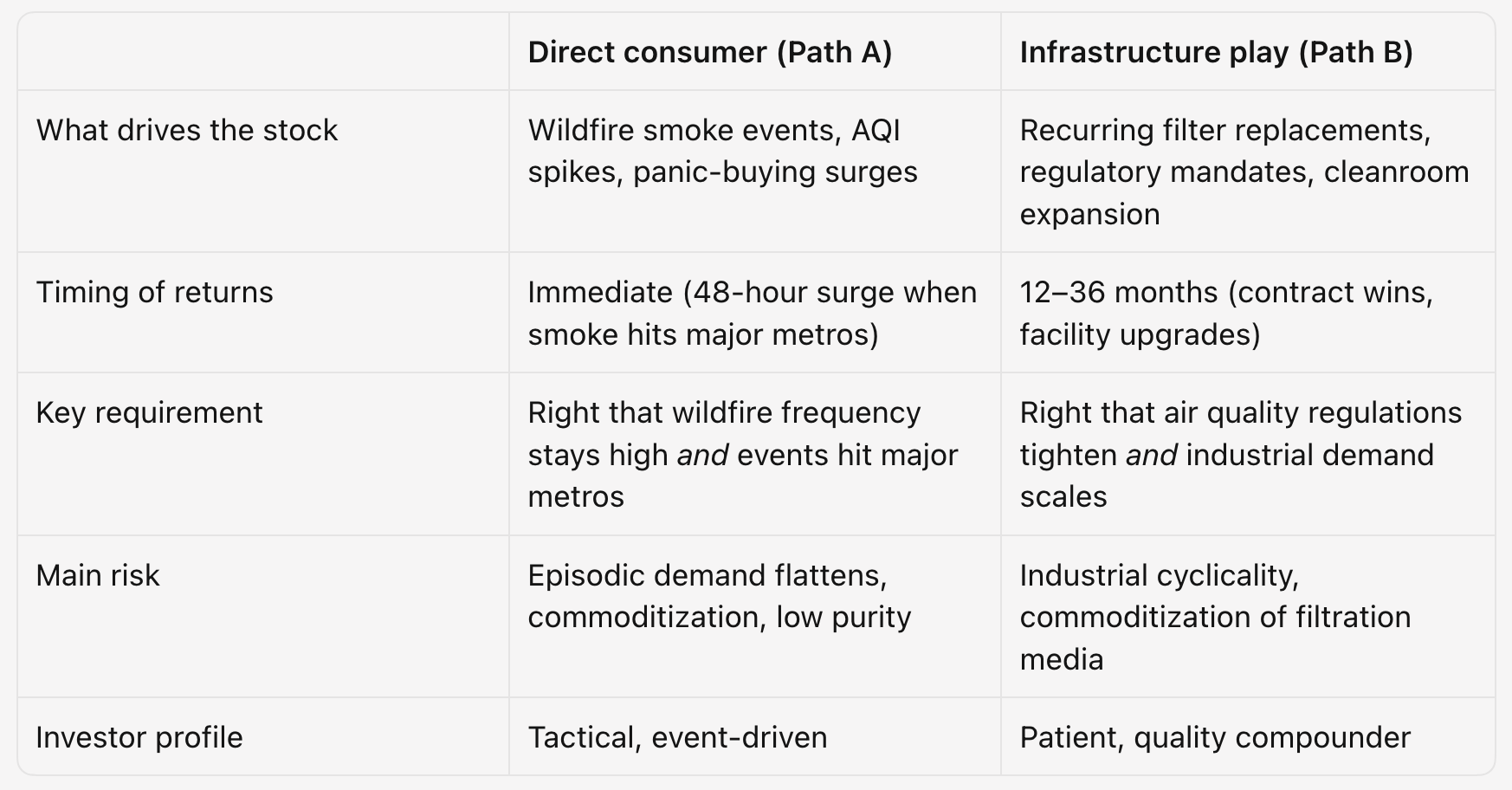
Neither path is “safe.” Path A is a leveraged bet on disaster headlines and consumer panic. Path B is a bet on structural demand for clean air in factories, hospitals, and fabs. A portfolio can hold both: direct exposure for the episodic surges when wildfire smoke blankets Chicago, infrastructure plays for the longer-term regulatory tailwind.
The US-listed names, by role
Restricting to companies buyable in a standard US brokerage (NYSE / Nasdaq):
Consumer air purification leaders: 3M (MMM) — N95 respirators, consumer HEPA filters; Whirlpool (WHR) — residential air purifiers, saw +7.6% stock surge during 2023 event; Honeywell (HON) — building automation, air quality systems; Unilever (UL) — owns air purifier brands in consumer health division.
HVAC & commercial filtration: Carrier Global (CARR) — HVAC systems, air quality solutions for commercial buildings; Johnson Controls (JCI) — building automation, HVAC filtration integration; Daikin Industries (not US-listed, but partners with US distributors).
Industrial filtration specialists: Donaldson Company (DCI) — engine, industrial, and life sciences filtration; just acquired Facet Filtration (May 2026); Parker Hannifin (PH) — motion control and industrial air filtration, cleanroom applications, 23.8% ROE.
Emerging pure-plays: Atmus Filtration Technologies (ATMU) — spun out from Cummins, focused on high-performance filtration media for industrial and cleanroom applications.
Materials & components: Camfil (private) — HEPA and ULPA filter media, major supplier to cleanrooms; MANN+HUMMEL (private) — automotive and industrial filtration; American Air Filter (AAF International, private) — commercial HVAC filtration.
For readers wanting exposure to consumer brands (Levoit, Molekule, Winix, Dyson, Oransi), most are private or owned by private equity. The US-listed plays are conglomerates (MMM, WHR, HON) or industrial specialists (DCI, PH). Full company profiles and market share breakdowns are in the research package.
The smoke signal: Who knew what, when?
Here’s where it gets uncomfortable. On July 15–16, 2026, as Canadian wildfire smoke began its descent into the Midwest, a predictable pattern unfolded: air purifier stocks jumped 7–8% within 48 hours. Whirlpool, Carrier Global, and Johnson Controls all saw gains as the smoke thickened. But unlike our CLARITY Act investigation, where we tracked CRO whale activity spiking +1,100% before the Citadel announcement, there’s no smoking gun of insider trading here.
Why? Because wildfire smoke events are visible days in advance. Meteorologists track smoke plumes. NOAA’s smoke forecasts are public. Air quality models predict AQI spikes 24–72 hours before they hit population centers. By the time smoke blankets Chicago, the “news” has already been priced into commodities, options, and futures.
Traders don’t need insider tips — they just need to read the wind.
But here’s the pattern worth watching: retail panic is predictable, and institutional players position accordingly. When AQI forecasts showed the 2026 smoke event would hit the Great Lakes region on July 16, anyone paying attention could have bought call options on MMM or WHR on July 14–15 and cashed out 48 hours later. It’s not insider trading. It’s just reading the room faster than retail investors googling “what’s that chemical smell?”
The real money isn’t in the episodic spikes. It’s in the structural shift. Wildfire seasons are getting longer. The 2023 Canadian fires emitted 1.3 billion metric tons of CO₂ — more than double Canada’s planned 10-year emissions reductions. The 2026 season is on track to match or exceed that. And climate models predict this is the new baseline, not an anomaly. North America is warming twice as fast as the global average. Canada’s Arctic regions are warming four times faster. Fire weather intensity is at least 2x more likely due to human-driven climate change, and the peak intensity is 20% higher because of it.
Institutional investors aren’t betting on one wildfire season. They’re betting on a permanent shift in air quality as a consumer category. When Donaldson acquired Facet Filtration in May 2026, it wasn’t a coincidence. When Carrier and Johnson Controls expanded their air quality divisions in 2025–2026, it wasn’t random. These companies are positioning for a decade-long tailwind where clean air becomes infrastructure, not a luxury.
The timeline tells the story:
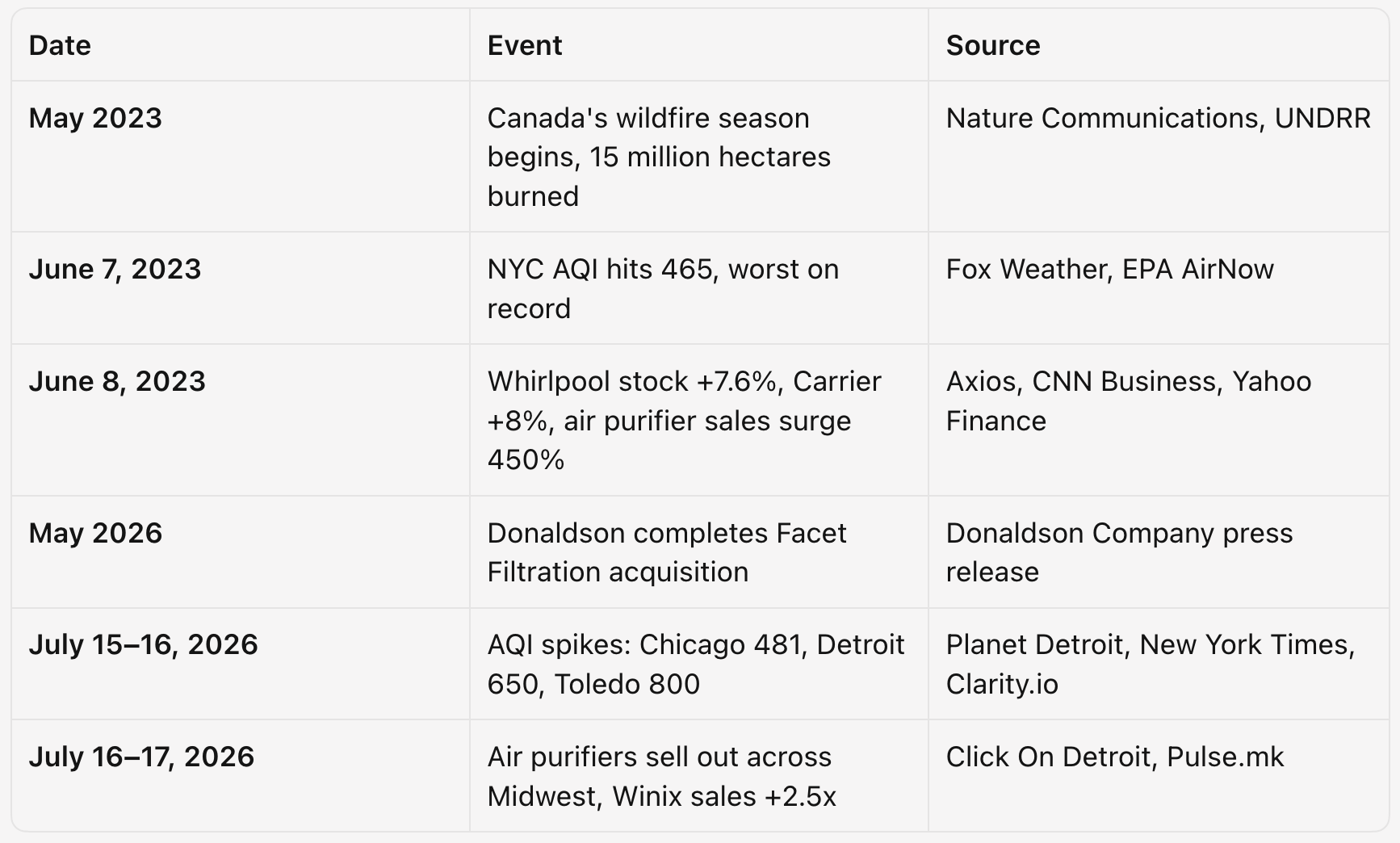
The difference between the CLARITY Act and this? In crypto, the whales front-ran public announcements with non-public information. In air filtration, the “whales” are just reading publicly available smoke forecasts and positioning before retail panic-buys air purifiers. It’s not illegal. It’s just faster.
Risks that apply to the whole theme
Wildfire frequency could stabilize (unlikely). If Canada implements aggressive fire suppression, controlled burns, and forestry management reforms, wildfire seasons could moderate. Climate models say the opposite: fire weather is 2x more likely due to climate change, and peak intensity is 20% higher. But if fires do decline, episodic surges in air purifier sales flatten, and Path A names reprice.
Commoditization. HEPA filters are mature technology. A $50 Levoit purifier on Amazon does 80% of what a $1,000 Dyson does. Margin compression is real, especially on consumer products. Industrial and cleanroom filtration have stickier pricing, but even there, cost competition is fierce.
Regulatory stall. The bull case assumes EPA and ASHRAE tighten indoor air quality standards, and states like California expand wildfire smoke mandates. If political winds shift and regulations loosen, the recurring revenue thesis weakens.
Execution risk (Path B). Donaldson’s Facet acquisition needs to integrate. Parker Hannifin’s filtration segment is one part of a massive conglomerate. If industrial cycles slow or cleanroom buildouts delay, growth projections miss.
Public fatigue. After repeated wildfire seasons, do consumers stop panic-buying purifiers and just accept hazardous air as the new normal? Behavioral adaptation is a risk — if people normalize pollution, episodic surges flatten.
What to watch
One signal captures whether air filtration is shifting from episodic to structural: recurring filter replacement subscriptions. If companies like 3M, Honeywell, or Carrier report growth in commercial HVAC filter replacement contracts — not just one-time purifier sales — that’s the tell. Watch for cleanroom expansion announcements from semiconductor and pharmaceutical companies; those are multi-year contracts with sticky recurring revenue.
On the episodic front, monitor NOAA smoke forecasts and AQI predictions for major metros. If smoke events hit the top 20 US cities (NYC, LA, Chicago, Houston, Phoenix), retail panic-buying surges are predictable. Track Google Trends for “air purifier” and Amazon bestseller rankings in home products — when filters dominate the top 50, the spike is live.
On the policy side, watch for EPA indoor air quality standard updates and ASHRAE ventilation guideline revisions. If the EPA tightens PM2.5 exposure limits or mandates HEPA filtration in public buildings, that’s the regulatory catalyst that turns air quality into infrastructure.
Bottom line
Air Quality as Infrastructure
The air filtration market isn’t about believing in climate change — it’s about acknowledging that AQI 650 in Detroit and AQI 800 in Toledo are now part of the seasonal forecast. 1.3 billion metric tons of CO₂ from Canadian wildfires in 2023. 130+ fires out of control in Ontario in 2026. Smoke reaching Europe and China. This isn’t a one-off disaster. It’s the baseline.
The US air filtration market is growing from $5.8 billion (2026) to $10.14 billion by 2035 at 6.4% CAGR. The global market is hitting $19.72 billion in 2026, projected to reach $33.80 billion by 2033 at 8.0% CAGR. HVAC filters alone are a $4.66 billion market growing to $6.21 billion by 2031. And industrial air filtration is scaling toward $10.78 billion by 2033.
The episodic surges are real: Whirlpool +7.6%, Carrier +8%, air purifier sales 5x to 10x overnight, Google searches +450%, shelves emptying in 48 hours. But the structural play is better: recurring filter replacements, HVAC contracts, cleanroom expansions, and regulatory mandates that turn clean air into a subscription business.
The question isn’t whether this happens. It’s whether you want exposure to the companies selling the solution — 3M for consumer N95s and HEPA filters, Donaldson for industrial and cleanroom filtration, Parker Hannifin for quality infrastructure with air quality tailwinds layered on top, Carrier and Johnson Controls for commercial HVAC contracts — or realize breathing clean air is no longer a given.
The planet can’t stop burning. Someone is selling the oxygen. And the market has already decided who profits.
Rubryk’s Rant
They told you climate change was a future problem. Turns out the future is right now, and it smells like burnt Canada.
AQI 874 in Detroit. 800 in Toledo. The EPA scale stops at 500, and we blew past it like it was a suggestion. Meanwhile, air purifiers are selling out faster than toilet paper in March 2020, and Whirlpool stock is up 7.6% while you’re duct-taping a box fan to a furnace filter and calling it “DIY resilience.”
The planet is on fire. The air is poison. And some executive at 3M is watching quarterly N95 sales charts with the same energy as a crypto bro tracking Dogecoin. This isn’t disaster capitalism. It’s disaster infrastructure. We’ve monetized the apocalypse.
And here’s the kicker: it’s not insider trading when the disaster is scheduled. NOAA publishes smoke forecasts. Meteorologists track fire plumes. By the time your X feed is full of green pool photos, institutional money already bought call options on MMM and CARR 48 hours earlier. You’re not late to the trade. You’re looking at the wrong calendar.
The wildfire-to-HEPA-filter-to-shareholder-value pipeline is so efficient it makes the CLARITY Act look like amateur hour. At least crypto whales had to front-run private Senate meetings. Air quality traders just need to read the fucking weather.
You don’t have to like it. But if you’re going to live in a world where breathing costs extra, you might as well know who’s cashing the checks.
About StatsLab
This is the second piece in our institutional infrastructure research series. If you read our CLARITY Act article, you watched us call COIN’s rally. You saw us track CRO whale activity spiking +1,100% before the public announcement. We don’t move markets. We just show you the structure before the headlines catch up.
StatsLab is an AI vision-powered trading intelligence platform built by traders who got tired of watching retail lose while institutions had all the tools.
What we do: Screenshot any chart. Our AI sees everything — patterns, indicators, support levels, the whole technical picture — and delivers institutional-grade analysis in 30 seconds. The same frameworks that Bloomberg Terminal users pay $24,000/year for, accessible to anyone with a trading idea.
Why we built it: Because they halted the buy button. Because they gated the intelligence. Because 90% of retail traders lose money, not because they’re stupid, but because they’re flying blind. We’re traders. We know what it’s like to miss the move because you didn’t see the structure until it was too late. So we built the platform that didn’t exist.
This research arm tracks the infrastructure being built beneath the narratives. The custody monopolies. The whale activity. The miner-to-AI pivots. The uncomfortable truths hiding in NOAA smoke forecasts and EPA AirNow data.
If you want research that treats you like an adult — no hype, no “10 stocks to buy now,” just structure, data, and the uncomfortable truths hiding in the footnotes — we’re opening beta access now.
Join the StatsLab beta to get the next piece in your inbox before the smoke clears.
StatsLab | Unlocking Financial Intelligence™
Welcome to the Platform Before the Trade™
This is research and commentary, not investment advice, and not a recommendation to buy or sell any security. Figures and market caps are as of July 2026 and move daily. AQI readings, wildfire data, and sales surge percentages are sourced from public data and verified news reports. The author may hold positions in names discussed. Do your own work. We are Not Financial Advisors. AI makes mistakes.